SpiderSwarm
Operator software for mapping, grouping, cueing, health, and safety-state orchestration.
Mysterio.tech · Intelligent Entertainment Robotics

Mysterio is developing SpiderSwarm, a proposed control platform for modular SpiderBot units with swappable ProjectionPod and VisionPod payloads across stages and venues, all managed as one operator-controlled system.
ILLUSTRATIVE CONCEPT Renderings and software simulation only. V1 functions, performance, and operating approvals remain to be built and validated.
01 / More than Meets the Eye
The credible first product is a modular spatial-media system: professional projection where power, cooling, structure, and serviceability are available; lightweight vision and calibration where mobility creates real value.
Fixed infrastructureCreative coverage is constrained by the original rig and venue geometry.
Bespoke resetsEach venue creates another placement, alignment, and commissioning problem.
Split controlMobility, media, calibration, telemetry, and safety are managed in separate layers.
Product architecture
Operator software for mapping, grouping, cueing, health, and safety-state orchestration.
A proposed modular robotic unit with a common payload interface and rig / perch / controlled-flight modes.
A proposed professional projection payload for tethered rigged and perched use.
A proposed lightweight camera, depth-sensing, and calibration payload for mobile capture and controlled flight.
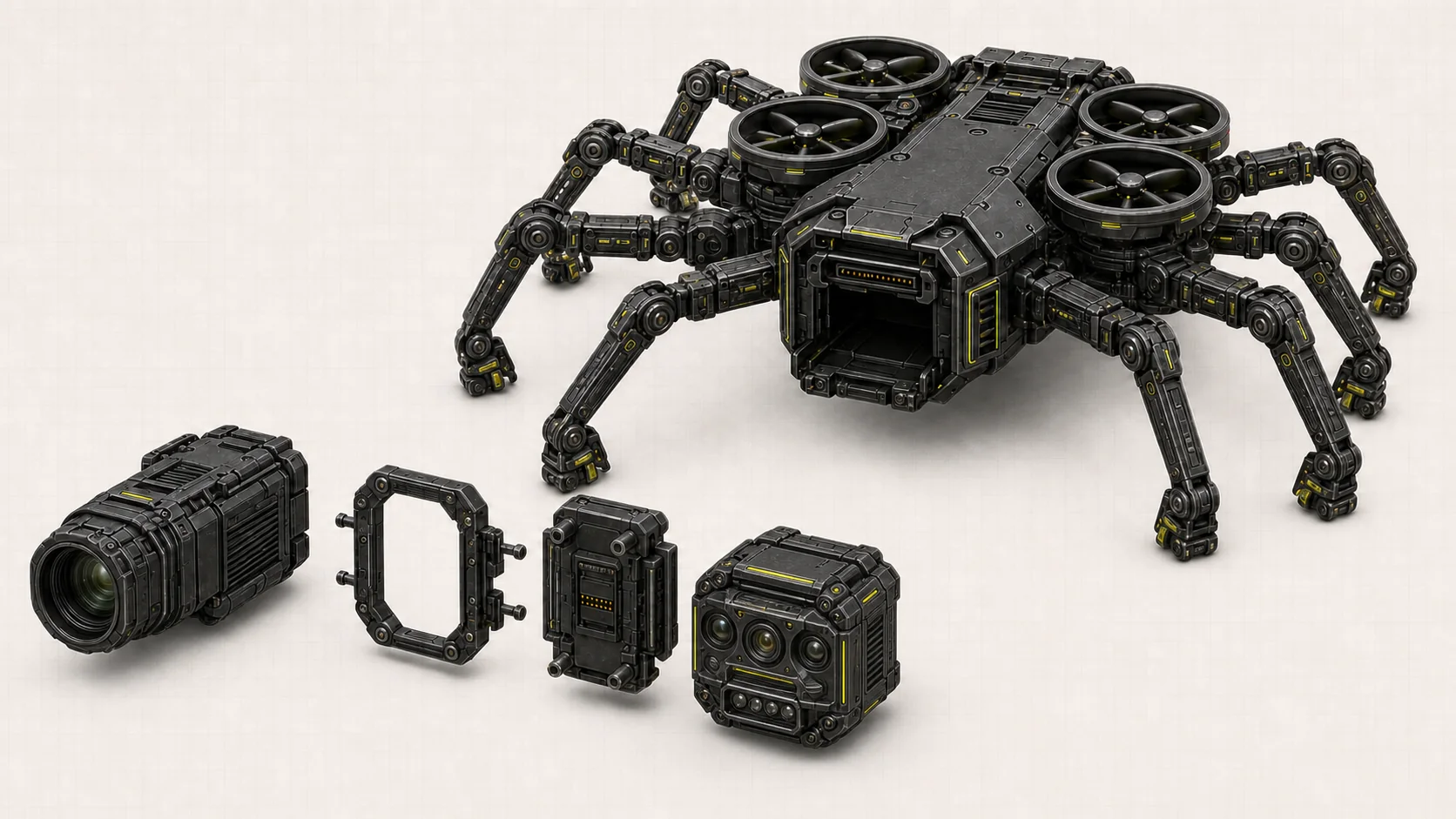 CONCEPT RENDER · COMMON INTERFACE PROPOSED
02 / Modular hardware
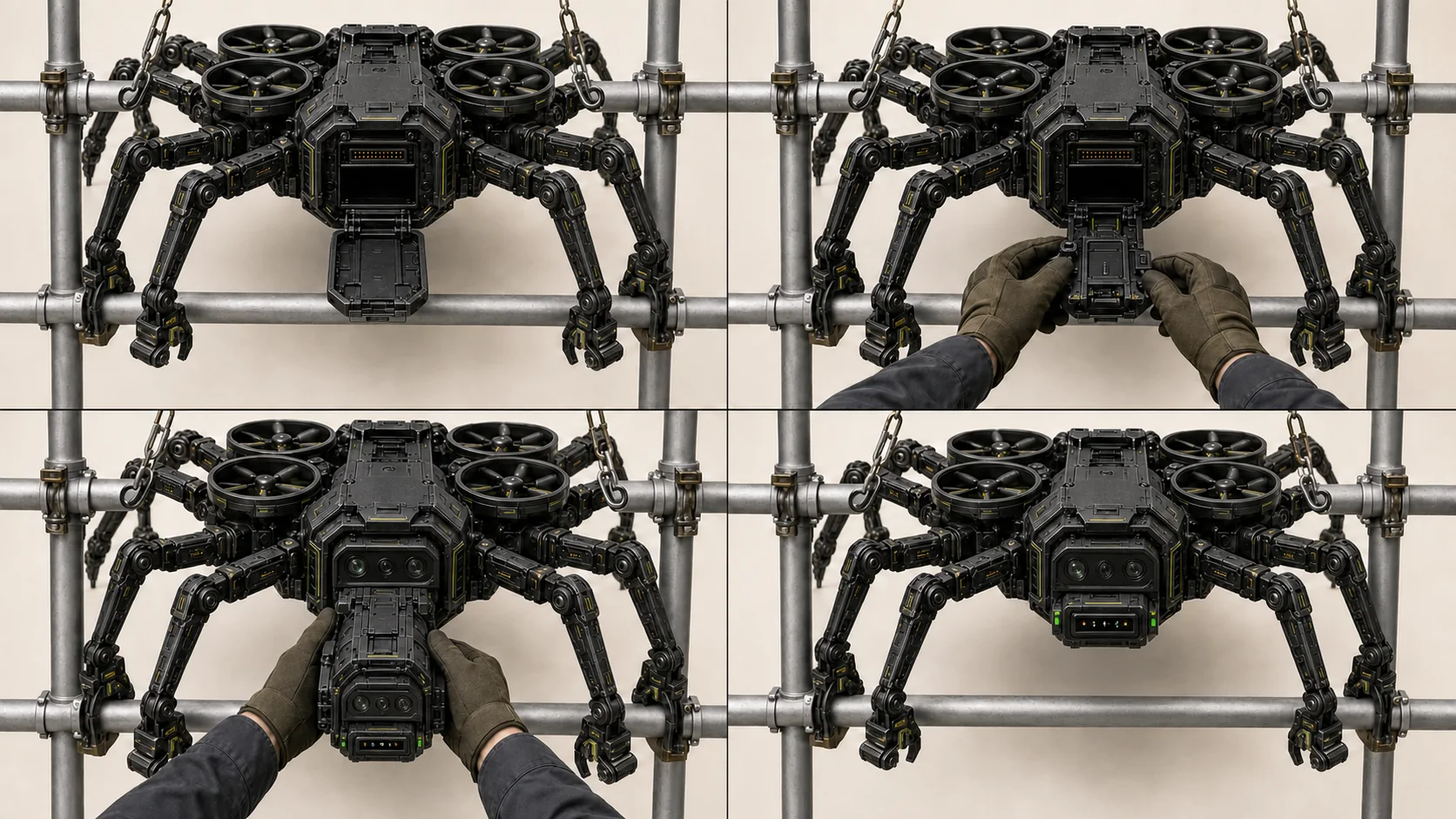
The proposed PodDock Mark 2 uses keyed guides, kinematic alignment, preload and independent secondary retention so a trained technician can assign the right payload to the right operating envelope.
Professional projector, gimbal, cooling, and calibration camera. Design target: tethered AC/data operation on rated rigs and perches.
Lightweight video, depth, and tracking sensors. Design target: capture and calibration from ground, perch, rig, or controlled flight zones.
03 / Proposed Field Service
VisionPod captures venue geometry and approved operating zones. The operator then assigns payloads and roles, deploys each SpiderBot to a rated position, and completes calibration and health checks before the show.
04 / SpiderSwarm control
Select a SpiderBot, an operating group, or the entire fleet. This working software interaction demonstrates scope selection, command-state changes, operator authority, and a simulated E-stop—without claiming a hardware connection.
SOFTWARE EVIDENCEInteractive prototype · no hardware connected
WORKING INTERACTION · NO HARDWARE CONNECTED
1 / 08 NODES
05 / Proposed show workflow
FUTURE STATEMobility changes placement, not authority. Playback begins only after the unit is stationary, retained, mapped, and approved by the show operator.
During load-in, place each unit at its approved service, rig, or perch position. Projection stays dark while the unit moves.
Confirm rated structure, tether or retention, payload mount, power/data, and the permitted operating mode.
From a stationary state, load venue geometry and calibrate pose, surfaces, brightness, color, and overlap.
Run approved media cues while the identified operator retains safe hold, blackout, and emergency-stop authority.
06 / Deployment matrix
V1 keeps professional projection on rated rig and perch positions. Controlled flight is a VisionPod research mode inside defined no-audience zones.

Swipe horizontally to compare operating modes
07 / Safety plane
PROPOSED Architecture requires validation and independent safety review.
Hold, blackout, land / park, and emergency stop remain available to an identified operator.
Rated placement, physical tethering where applicable, and software-defined zones constrain permitted motion.
The proposed module identity prevents a payload from being assigned to an unapproved operating mode.
Loss of link, pose confidence, power margin, or thermal headroom triggers a predefined safe response.
08 / 90-day feasibility sprint
The sprint turns the concept into measured answers on photometrics, thermal load, synchronization, fault response, and operator workflow. Each phase ends in a documented go / no-go gate.
FUTURE STATE 90-day timing is a proposed planning target.
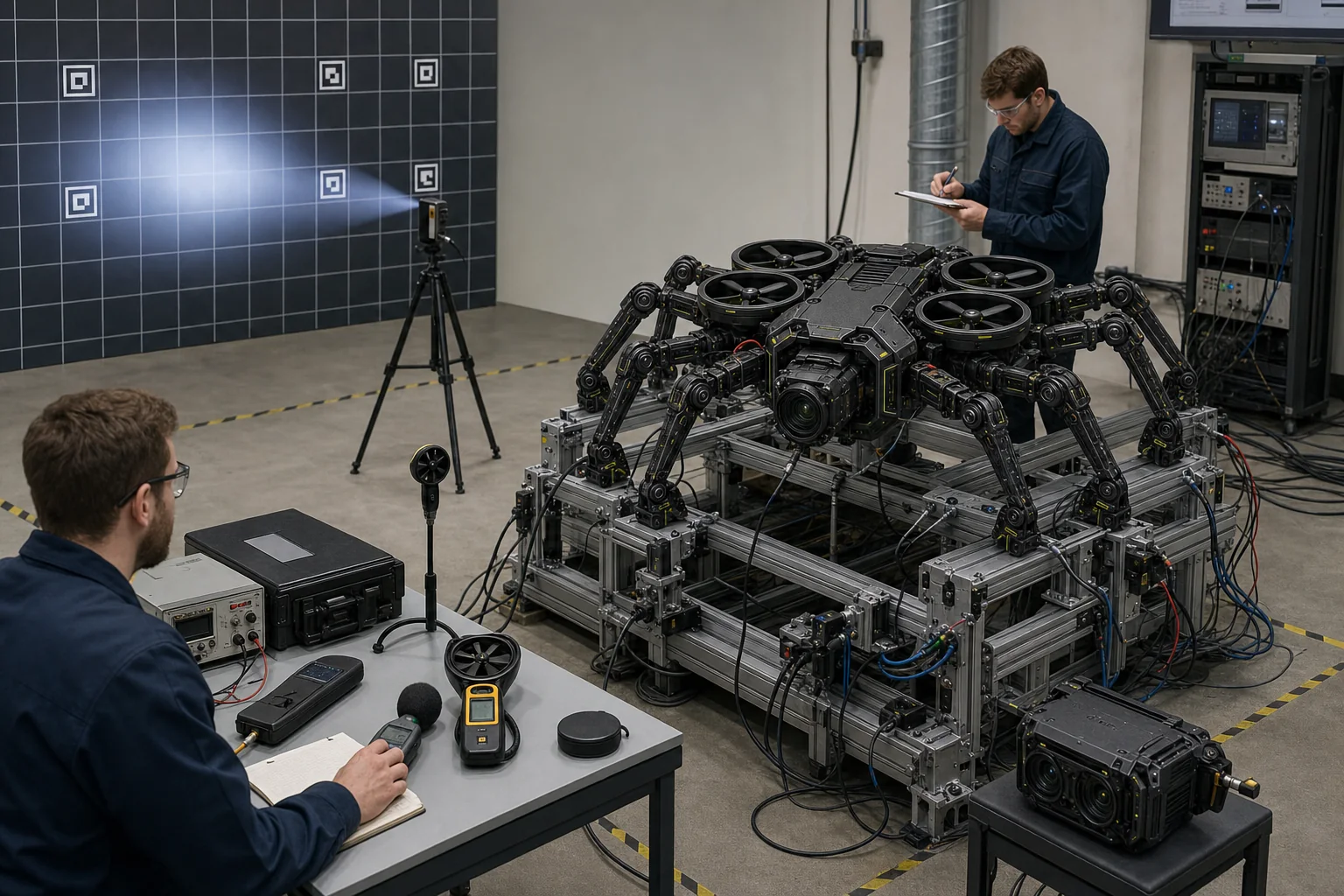
Measure payload mass, thermal load, acoustics, photometrics, power, and the tool-less interface.
GO / NO-GO GATEDemonstrate repeatable placement, optical calibration, synchronized media, health telemetry, and safe hold.
GO / NO-GO GATERun a non-public mock show with a production partner, documented operating procedures, and stop drills.
GO / NO-GO GATEControlled proof partner
We’re looking for one production partner, one controlled venue, and the engineering collaborators needed to turn design targets into measured evidence.